The 2026 CKM guideline recognizes what many patients already experience: heart, kidney, metabolic, and weight-related conditions cannot be managed effectively in silos.
Key takeaway
CKM recognizes that obesity, diabetes, kidney disease, and cardiovascular disease are interconnected. For appropriate higher-risk patients, the 2026 guideline recommends interdisciplinary care with a defined CKM coordination point person — a role a small practice is often better positioned to fill than a large system.
A patient with obesity, diabetes, hypertension, and chronic kidney disease may see a primary care clinician, a cardiologist, an endocrinologist, a nephrologist, and several other members of the care team. Each of them may provide excellent care. Yet one basic question often goes unanswered:
Who is looking across the entire picture?
That question matters because cardiovascular, kidney, and metabolic diseases do not behave like separate conditions. They interact, accelerate one another, and increasingly share the same treatments. In 2026, major professional societies formally recognized this reality.
What Changed in the 2026 CKM Guideline
The 2026 AHA/ACC/ADA/ASN guideline brings conditions long treated in separate lanes into a single clinical framework: cardiovascular-kidney-metabolic (CKM) syndrome. CKM describes the interconnected relationships among metabolic risk factors — including obesity and type 2 diabetes — chronic kidney disease, and cardiovascular disease.¹ Parallel guidance from the American Society of Nephrology frames the same syndrome from the kidney perspective, reinforcing that these conditions belong in one clinical conversation rather than several.²
Within this framework, obesity is not simply an isolated diagnosis. It can be an important driver of CKM risk and progression.
The guideline's organizational recommendation is especially important. For adults with stage 2–4 CKM syndrome who have at least two of diabetes, CKD, and/or cardiovascular disease, it recommends interdisciplinary care teams with a CKM care coordination point person to facilitate multisystem care, including lifestyle intervention and optimization of guideline-directed medical therapy. This is a Class 1, Level B-R recommendation.¹
The guideline also recommends addressing adverse social determinants of health as part of interdisciplinary CKM care, including involving community health workers, social workers, and patient navigators when appropriate.¹
The message is increasingly clear: coordination is no longer an optional extra. It is becoming part of evidence-based cardiometabolic care.
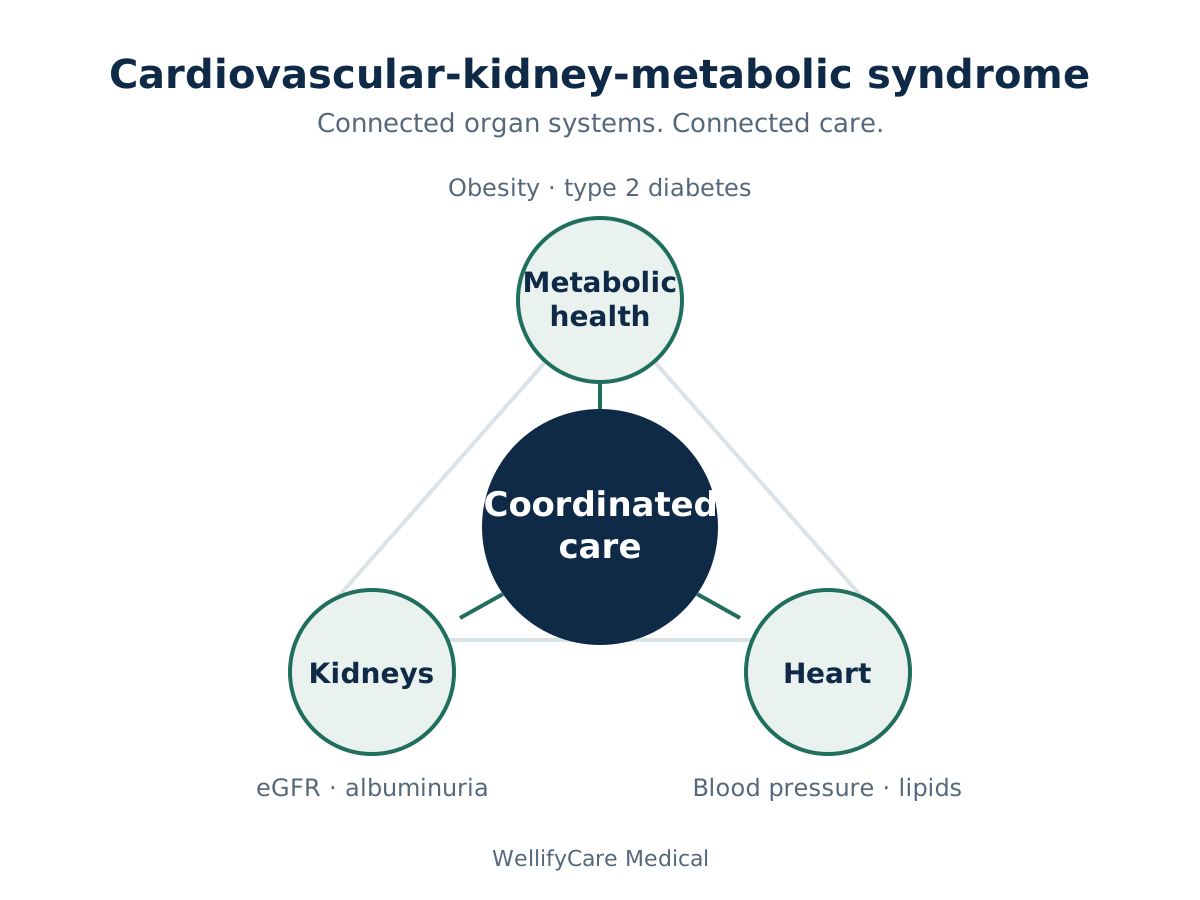
The heart, kidneys, metabolism, and weight are connected. Our model of care should be connected too.
Why Fragmented Care Matters
Guidelines can identify the need for coordination, but most healthcare systems were never designed around it.
Cardiometabolic care sits at the intersection of several specialties whose responsibilities naturally overlap. Primary care clinicians, cardiologists, endocrinologists, nephrologists, pharmacists, and other team members may all address blood pressure, cholesterol, glucose, weight, kidney function, and cardiovascular risk.
That overlap is not inherently a problem. The problem arises when several people are responsible, but no one is clearly responsible for connecting the entire picture. When ownership of individual decisions becomes unclear, treatment can stall, because each clinician may reasonably assume someone else is addressing the issue.⁴
Shared responsibility without clear coordination can become no responsibility at all.
One of the most visible consequences is the underuse of therapies already known to prevent cardiovascular events, slow kidney disease progression, and improve outcomes. In one large health system, the gap between eligibility and treatment looked like this:
83%
of adults with type 2 diabetes had a cardiovascular or kidney indication for an SGLT2 inhibitor and/or GLP-1 receptor agonist
33%
had an active prescription for one⁶
National estimates are worse. In NHANES data, a similar share met criteria for these agents, but under one in ten were taking one.
These gaps are not evenly distributed. Among Medicare beneficiaries with type 2 diabetes and newly diagnosed ASCVD or heart failure, adoption of SGLT2 inhibitors and GLP-1 receptor agonists was lower among Black patients and among people living in more socioeconomically deprived communities.⁷
This is not a story of bad clinicians. It is a story of a healthcare system that was never designed for diseases that refuse to stay inside one specialty's lane.
Fragmentation itself may carry measurable risk. In a Danish nationwide cohort, greater healthcare fragmentation was independently associated with more potentially inappropriate medication use and higher mortality.⁸ Conversely, among more than 312,000 patients with type 2 diabetes, greater team-based continuity of care was associated with progressively lower cardiovascular risk.⁹
Continuity is not simply a convenience. These are observational findings, but they point in a consistent direction: how care is organized appears to matter clinically, not only administratively.
What Coordinated CKM Care Looks Like
The solution is not to create another silo. It is to build an interdisciplinary model with someone clearly responsible for coordinating the whole picture. The 2026 guideline describes adaptable models that can operate in person, virtually, or through a combination of both.¹
At the center is the CKM care coordination point person. That role may include:
Comprehensive medication review and reconciliation
Supporting initiation and titration of evidence-based therapies
Helping patients understand and access medications
Facilitating lifestyle change
Coordinating communication across clinicians
Helping patients navigate a complex healthcare system¹
The evidence supporting structured coordination is growing.
In the COORDINATE-Diabetes cluster-randomized trial, prescription of all three recommended evidence-based therapy groups rose from 14.5% with usual care to 37.9% with a coordinated-care intervention.⁵
Longer-term, team-based studies point in the same direction: multidisciplinary, multifactorial care can improve cardiovascular risk factors, glycemic control, and blood pressure, and, in selected populations, long-term outcomes.¹,¹⁰
But coordination by itself is not enough.
The goal is not more communication. The goal is communication that leads to action.
A coordinator empowered to reconcile medications, facilitate initiation and titration, identify treatment gaps, and close the loop is far more likely to influence outcomes than one limited mainly to relaying messages.
In practice, coordinated CKM care means doing several things consistently: identifying a coordination point person, clarifying who manages each major risk factor, using evidence-based treatment pathways, finding eligible-but-untreated patients through EHR or registry tools, incorporating pharmacists and other team members, and deliberately protecting continuity and equity.¹,⁵
What This Looks Like in a Small Practice
Most of the coordination literature describes large systems: multidisciplinary clinics, embedded pharmacists, registry teams. That can make coordinated CKM care sound like something only an academic center can deliver.
The opposite is closer to the truth.The guideline does not say this. It says coordination models must be adaptable to differences in subspecialty density and local resources. What follows is my reading of what that adaptability means for a practice like mine
Fragmentation is largely a problem of scale. When a patient sees five clinicians across three organizations, someone has to be assigned to connect the picture. In a small practice, no one has to be assigned. The physician who sees the patient is already the coordination point person — the guideline's Class 1 recommendation describes, by default, how a small practice already works.¹
The advantage is structural, not aspirational. But it only becomes real if a few things are done deliberately.
Capture the whole picture once. CKM staging requires weight and body composition, blood pressure, lipids, glucose or A1c, eGFR, and albuminuria. Most patients have some of these scattered across years and systems. A single intake that gathers all of them — including the albuminuria that so often goes unordered — is what turns a set of diagnoses into a stage.
Know who is eligible and untreated. The largest gap in cardiometabolic care is not diagnosis, it is untreated eligibility.⁶ A health system needs a registry team to find those patients. A practice with a few hundred patients needs a list and a recurring hour. The question is simply: who on my panel has an indication for an SGLT2 inhibitor or GLP-1 receptor agonist and is not on one, and why not?
Decide what happens between visits. Blood pressure, weight, glucose, and adherence move continuously; quarterly visits sample them four times a year. Structured follow-up between visits is where titration actually happens.
Build the team outward instead of inward. A small practice will not employ a pharmacist, a dietitian, an exercise physiologist, and a behavioral health clinician. It does not need to. It needs working relationships with them, and a clear understanding of who is doing what. Interdisciplinary does not require shared employment. It requires shared responsibility that is actually assigned.¹
Protect continuity, because it is the one thing a small practice does best. Team-based continuity is associated with lower cardiovascular risk.⁹ Continuity is not a byproduct of small practice; it is the clinical product.
None of this requires new technology or new evidence. It requires deciding that someone owns the whole picture, and then behaving that way.
How Technology Can Help
Technology can make coordinated CKM care more scalable when it supports — rather than replaces — clinical relationships.
Telehealth is particularly well suited to CKM care because these conditions require longitudinal attention. Blood pressure, glucose, weight, symptoms, medications, physical activity, and adherence all evolve between office visits, and remote care can help clinicians see those changes earlier. Connected devices and structured follow-up can support more timely medication adjustment.¹³
Well-designed electronic records can improve clinician-to-clinician communication, embed evidence-based pathways, and track important metrics longitudinally.¹⁴ Remote specialty support can extend expertise beyond traditional referral models, particularly where access to subspecialists is limited.¹¹,¹⁴ Clinical decision support may also help identify patients who qualify for therapies but have not yet received them.
Technology should be the connective tissue of coordinated care — not the center of care.
The evidence should also temper enthusiasm. A 2025 scoping review found encouraging results for telehealth, particularly for glycemic control and self-management, but evidence for broader cardiovascular-risk improvement remained heterogeneous.¹² Digital care can also widen disparities if we ignore broadband access, digital literacy, language, affordability, and patients' ability to use connected devices.¹³,¹⁴
The right question, then, is not simply, “Can this visit be virtual?” It is: What combination of technology, human support, and in-person care gives this patient the best chance of succeeding?
What This Means for the Future of Cardiometabolic Care
The emerging CKM framework asks us to think differently about chronic disease. Obesity, diabetes, hypertension, dyslipidemia, kidney disease, and cardiovascular risk are not simply separate diagnoses that happen to occur in the same person. They are often interconnected expressions of the same underlying cardiometabolic process.
Better care requires someone to see the whole patient, not just the diagnosis in front of them. That means identifying risk early, and using predicted risk and expected treatment benefit — rather than each risk factor in isolation — to guide what we do about it.³ It means making sure evidence-based therapies are actually implemented. It means coordinating care across conditions and specialties. And it means following patients longitudinally rather than treating each visit as an isolated event.
The 2026 CKM guideline gives this coordinating role a name: the CKM care coordination point person. More importantly, it gives healthcare systems a challenge:
Organize care around the patient — not around the specialty.
Technology can help make that possible. Telehealth, remote monitoring, shared data, clinical decision support, and better communication systems can make longitudinal care easier to deliver. But technology remains a tool. The relationship, judgment, accountability, and coordination remain human.
At WellifyCare Medical, this integrated view of cardiometabolic health is central to how we think about prevention and chronic disease management. Our goal is simple: understand the whole risk picture, intervene earlier, coordinate care thoughtfully, and help patients protect their health across the years — not simply manage one number or one diagnosis at a time.
The science has connected the heart, kidneys, metabolism, and weight. Our models of care now need to catch up.
Dereje Tefera Siyum, MD, MSHI, DABOM
Founder & Physician, WellifyCare Medical
Internal Medicine | Obesity Medicine | Clinical Informatics
This article is for general educational purposes and is not a substitute for individualized medical advice. Talk with your clinician about what is right for you.
References & Further Reading
Ndumele CE, Rodriguez F, Dixon DL, et al. 2026 AHA/ACC/ADA/ASN Guideline for the Prevention, Detection, Evaluation, and Management of Cardiovascular-Kidney-Metabolic Syndrome. J Am Coll Cardiol. 2026.
Navaneethan SD, Rifkin B, Mottl AK, on behalf of the ASN Kidney Health Workgroup. Executive Summary of the ASN Kidney Health Guidance on the Cardiovascular-Kidney-Metabolic Syndrome. J Am Soc Nephrol. 2026.
Khan SS, Ndumele CE, Bhave N, et al. Use of Predicted Risk and Expected Benefit to Guide Decision-Making in Cardiovascular-Kidney-Metabolic Syndrome for the Primary Prevention of Cardiovascular Disease. J Am Coll Cardiol. 2026.
Chang LS, Vaduganathan M, Plutzky J, Aroda VR. Bridging the Gap for Patients with Diabetes and Cardiovascular Disease Through Cardiometabolic Collaboration. Curr Diab Rep. 2019.
Pagidipati NJ, Nelson AJ, Kaltenbach LA, et al. Coordinated Care to Optimize Cardiovascular Preventive Therapies in Type 2 Diabetes (COORDINATE-Diabetes). JAMA. 2023.
Blood AJ, Chang LS, Colling C, et al. Type 2 Diabetes Disease and Management Patterns Across a Large, Diverse Healthcare System. Am Heart J. 2025.
Cromer SJ, Lauffenburger JC, Levin R, Patorno E. Deficits and Disparities in Early Uptake of GLP-1 Receptor Agonists and SGLT2i Among Medicare-Insured Adults. Diabetes Care. 2023.
Prior A, Vestergaard CH, Vedsted P, et al. Healthcare Fragmentation, Multimorbidity, Potentially Inappropriate Medication, and Mortality: A Danish Nationwide Cohort Study. BMC Med. 2023.
Chan KS, Wan EYF, Chin WY, et al. Association Between Team-Based Continuity of Care and Risk of Cardiovascular Diseases Among Patients With Diabetes. Diabetes Care. 2022.
Lee JK, McCutcheon LRM, Fazel MT, Cooley JH, Slack MK. Assessment of Interprofessional Collaborative Practices and Outcomes in Adults With Diabetes and Hypertension in Primary Care. JAMA Netw Open. 2021.
Valabhji J, Hope D, Sayed NE, et al. Interventions for the Prevention and Management of Cardiometabolic Multiple Long-Term Conditions. Lancet. 2026.
Estêvão MD, Fernandes MT, De Sousa-Coelho AL, Espírito-Santo M, Nascimento T. Telehealth for Integrated Cardiovascular and Diabetes Management: A Scoping Review. J Diabetes Res. 2025.
Takahashi EA, Schwamm LH, Adeoye OM, et al. An Overview of Telehealth in the Management of Cardiovascular Disease: A Scientific Statement From the American Heart Association. Circulation. 2022.
Agarwala A, Patel J, Stephens J, et al. Implementation of Prevention Science to Eliminate Health Care Inequities in Achieving Cardiovascular Health: A Scientific Statement From the American Heart Association. Circulation. 2023.
